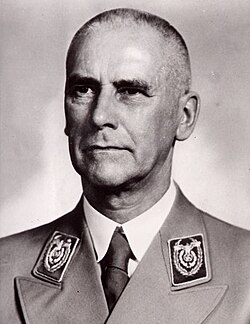
Wilhelm Frick
March 12, 1877 – October 16, 1946
German Nazi politician who was Reich Minister of the Interior from 1933 to 1943 and later Reich Protector of Bohemia and Moravia. Convicted at the Nuremberg trials, he was executed in 1946.
Biography
Wilhelm Frick was born in 1877 in Alsenz in the Bavarian Palatinate, the son of a Protestant schoolteacher. After the Gymnasium in Kaiserslautern he studied philology in Munich and then law at Heidelberg and Berlin, taking a doctorate in law in 1901. He entered the Bavarian civil service in 1903 as a lawyer with the Munich police, served as a district official in Pirmasens, and returned to the Munich police in 1917, where he came to know Adolf Hitler and helped the early Nazi movement obtain permits for rallies.
As head of the political department of the Munich police he took part in the failed Beer Hall Putsch of November 1923. Tried in 1924 for aiding high treason, he received a suspended sentence. He entered the Reichstag in May 1924 on the National Socialist Freedom Movement list, joined the refounded Nazi Party in 1925 and became leader of its Reichstag group in 1928. In January 1930 he became interior and education minister of Thuringia, the first Nazi to hold ministerial office in Germany, until a no-confidence vote removed him in April 1931.
When Hitler became chancellor in January 1933, Frick was named Reich Minister of the Interior. He drafted much of the legislation that brought the German states and institutions under Nazi control and that excluded Jews from public life, including the Nuremberg Laws of 1935, and his ministry enforced the 1933 sterilisation law. Hitler made him a Reichsleiter in 1933, and in 1934 he also took over the Prussian interior ministry. His power waned as Heinrich Himmler built up the SS and police, and in August 1943 Himmler replaced him as interior minister.
Frick stayed in the cabinet without portfolio and served as Reich Protector of Bohemia and Moravia from 1943 until the German surrender in 1945. Tried before the International Military Tribunal at Nuremberg, he declined to testify, was convicted of crimes against peace, war crimes and crimes against humanity, and was hanged on 16 October 1946.
Offices held
2 terms
- Jan 30, 1933 – Aug 20, 1943
- Aug 24, 1943 – Apr 30, 1945 Reichsminister without Portfolio
Affiliations
Education
- from Jan 1, 1896 LMU Munich LMU Munich, philology after his 1896 Abitur
- Heidelberg University Heidelberg University, law studies before his 1901 doctorate; no dates given
- Humboldt University of Berlin Friedrich Wilhelm University of Berlin (now Humboldt University), law studies; no dates given
- University of Göttingen


