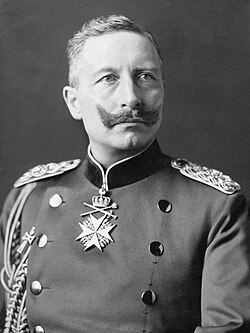
Wilhelm II
January 27, 1859 – June 4, 1941
Last German Emperor and King of Prussia (1888-1918), whose erratic foreign policy and naval build-up preceded the First World War; he abdicated in 1918 and died in exile in the Netherlands.
Biography
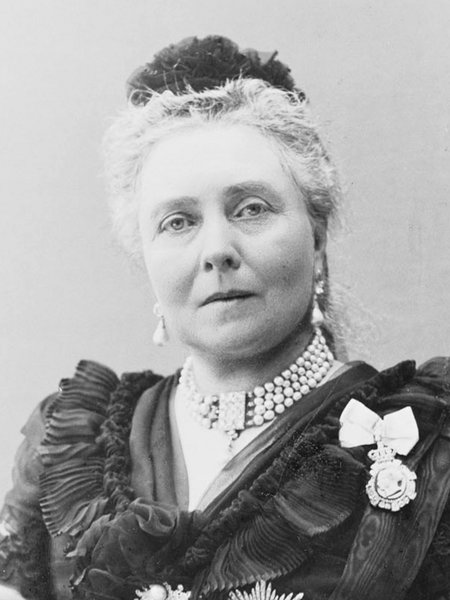
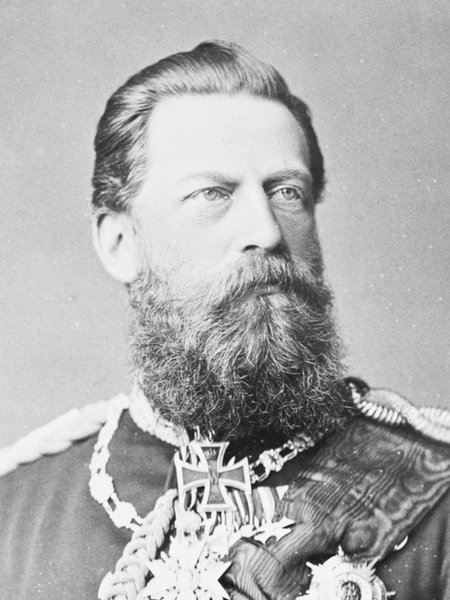
Wilhelm was born in Berlin in 1859, the son of Prince Frederick William of Prussia, later Frederick III, and of Victoria, Princess Royal, which made him the eldest grandchild of Queen Victoria. After school at Kassel he spent four terms studying law and politics at the University of Bonn. His father reigned for only 99 days in 1888, and Wilhelm succeeded him in June as German Emperor and King of Prussia.
In March 1890 he forced the resignation of Chancellor Otto von Bismarck and began a 'New Course' of more personal rule. Germany acquired territory in China and the Pacific and became Europe's largest manufacturer, but Wilhelm repeatedly caused diplomatic damage with impulsive interventions: the Kruger telegram of 1896, the 'Hun speech' of 1900, the 1905 visit to Tangier that set off the First Moroccan Crisis, and the 1908 Daily Telegraph interview. His backing for a large battle fleet drew Germany into a naval race with Britain.
In July 1914 he guaranteed German support to Austria-Hungary, and the crisis grew into the First World War. During the war he left strategy largely to the Supreme Army Command, which from 1916 dominated the government.
Facing military defeat and revolution, Wilhelm abdicated in November 1918 and went into exile in the Netherlands, where he lived at Doorn. He remained there under the German occupation of 1940 and died in June 1941.
Offices held
Affiliations
Education
- from Jan 1, 1877 University of Bonn Four terms studying law and politics