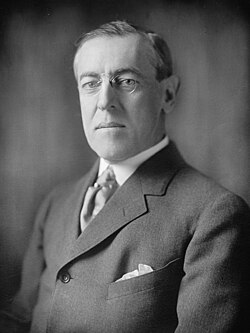
Woodrow Wilson
December 28, 1856 – February 3, 1924
Woodrow Wilson (1856–1924) was the 28th president of the United States, serving from 1913 to 1921. A Democrat — the only one to hold the presidency during the Progressive Era — he led the United States through World War I and was the leading architect of the League of Nations; his foreign-policy stance came to be known as Wilsonian idealism. Before the presidency he was a PhD historian who served as president of Princeton University.
Biography
Woodrow Wilson was the 28th president of the United States, from 1913 to 1921. A political scientist, he was president of Princeton University and then governor of New Jersey.
His first term created the Federal Reserve and the Federal Trade Commission and lowered tariffs. He kept the US neutral in the First World War until 1917, then led it into the war against Germany. His Fourteen Points set out his aims for the peace.
At the Paris Peace Conference he championed the League of Nations, for which he received the Nobel Peace Prize, but the Senate refused to ratify the treaty. His administration also extended racial segregation in the federal civil service. A stroke in 1919 left him disabled for the rest of his term.
Offices held
John Franklin Fort Succeeded by
James Fairman Fielder
William Howard Taft Succeeded by
Warren G. Harding


