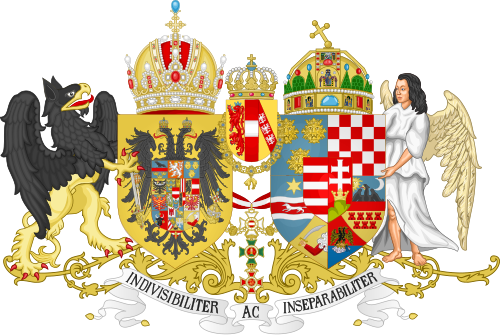
Austria-Hungary
State · 1867–1918 · Capital: Vienna, Budapest
Austria-Hungary, also called the Austro-Hungarian Empire, was a multi-national empire in Central Europe under a constitutional dual monarchy that existed between 1867 and 1918. It was formed by the Austro-Hungarian Compromise of 1867 after the Austro-Prussian War, joining the Austrian Empire and the Kingdom of Hungary as two largely self-governing states under a single monarch titled both Emperor of Austria and Apostolic King of Hungary. One of Europe's major powers, it was the second-largest country in Europe by area and the third-most populous. It was dissolved at the end of World War I after Hungary terminated the union with Austria in 1918.
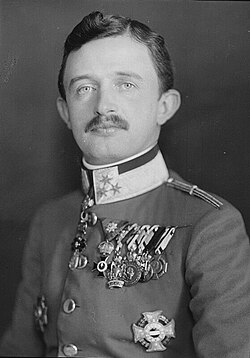
Office holders on October 31, 1918
Offices
| Office | Holders | Years |
|---|---|---|
| Emperor | 4 | 1804–1918 |
Relations
- Member of Triple Alliance (1882–1915)
- Successor of Austrian Empire (1867–)
- Succeeded by: Czechoslovakia (1918–), Austria (1918–), Hungary (1918–)
- Parties and groups: Young Czech Party, Deák Party
Military units
Austro-Hungarian Army · 1st Army (Austria-Hungary) · 4th Army (Austria-Hungary) · 5th Army (Austria-Hungary) · Austro-Hungarian 11th Army (1916–1918) · 12th Army (Austria-Hungary) · 2nd Army (Austria-Hungary) · 3rd Army (Austria-Hungary) · 6th Army (Austria-Hungary) · 7th Army (Austria-Hungary) · Army Group Archduke Karl · Polish Legions in World War I