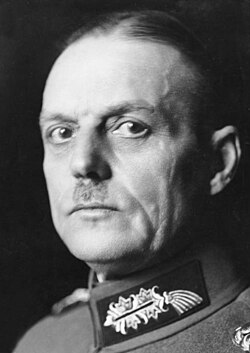
Gerd von Rundstedt
December 12, 1875 – February 24, 1953
Gerd von Rundstedt (1875-1953) was a German field marshal (Generalfeldmarschall) in the Army of Nazi Germany and Commander-in-Chief in the West during World War II. At the end of the war he was the German Army's most senior officer.
Biography
Gerd von Rundstedt was born in Aschersleben in 1875 into an old Prussian Junker family with a long tradition of army service. After cadet schools at Diez and Lichterfelde he joined the 83rd Infantry Regiment in 1892, was commissioned in 1893, and attended the War Academy in Berlin from 1903 before joining the General Staff in 1907. In the First World War he served mainly as a staff officer, in Belgium, in occupied Poland and with corps on the Eastern Front and in Alsace.
He stayed in the much reduced Reichswehr after 1918 and rose steadily to command a cavalry division in 1928. In July 1932, when Chancellor Franz von Papen deposed the Prussian government, Rundstedt was briefly made plenipotentiary under martial law in Berlin. Under Hitler he professed to stay out of politics while disliking the regime; he defended General Werner von Fritsch during the Blomberg-Fritsch affair of 1938 and retired that autumn as a colonel general.
Recalled in 1939, he commanded Army Group South in Poland, Army Group A in the 1940 campaign in France, after which he was made a field marshal, and Army Group South in the invasion of the Soviet Union, where his forces encircled Kiev. Hitler dismissed him in December 1941 for allowing a retreat from Rostov but in 1942 appointed him Commander-in-Chief West. He was relieved after the Allied landings in Normandy, reinstated in September 1944, and finally dismissed in March 1945. After the 20 July plot he chaired the army Court of Honour that expelled suspected officers so that the People's Court could try them. Orders he issued or endorsed, including the Commando Order and the Reichenau Order, later formed the basis of war crimes charges.
Taken prisoner in 1945, he testified as a defence witness for the army high command at Nuremberg in 1946. The British charged him with war crimes in 1949 but released him in May that year as unfit to stand trial. He died in Hanover in February 1953.
Military service
- Army Group South Commander
Affiliations
Education
- Jan 1, 1903 – Jan 1, 1906 Prussian Military Academy Kriegsakademie (War Academy), Berlin: three-year staff officer course from 1903


