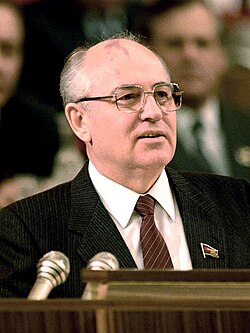
Mikhail Gorbachev
March 2, 1931 – August 30, 2022
Mikhail Gorbachev (1931-2022) was a Soviet and Russian politician who was the last leader of the Soviet Union, serving from 1985 until the country's dissolution in 1991. He served as General Secretary of the Communist Party from 1985 and additionally as head of state from 1988. Born into a peasant family, he rose through the party ranks in Stavropol and Moscow, joining the Politburo as a voting member in the early 1980s.
Biography
Mikhail Gorbachev was born in 1931 into a peasant family in the Stavropol region of southern Russia. He studied law at Moscow State University, rose through the Communist Party in Stavropol, and joined the Politburo in Moscow in 1980.
In March 1985 he became General Secretary. He launched glasnost (openness) and perestroika (restructuring) to revive the stagnant Soviet system, withdrew Soviet troops from Afghanistan, and signed arms-control treaties with Ronald Reagan. In 1989 he let the communist regimes of Eastern Europe fall without using force, and Germany reunited in 1990. He received the Nobel Peace Prize that year.
His reforms also released nationalist movements and economic disorder inside the Soviet Union. Hardliners tried to remove him in a coup in August 1991; it failed, but power passed to Boris Yeltsin and the republics. Gorbachev resigned on 25 December 1991, and the Soviet Union was dissolved. He died in 2022.
Offices held
Konstantin Chernenko Succeeded by
Vladimir Ivashko
Affiliations
Party membership
- Jan 1, 1950 – Jan 1, 1991 Communist Party of the Soviet Union


.jpg)