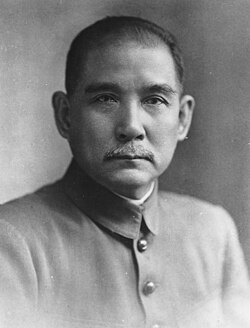
Sun Yat-sen
November 12, 1866 – March 12, 1925
Sun Yat-sen (1866–1925) was a Chinese physician, revolutionary, and political philosopher who founded the Republic of China and the Kuomintang (KMT). He is credited with leading the 1911 Revolution that overthrew the Qing dynasty. He served as the first president of the Provisional Government of the Republic of China in 1912 and as the inaugural premier of the Kuomintang.
Biography
Sun Yat-sen grew up partly in Hawaii and trained as a doctor in Hong Kong. Convinced that the Qing dynasty had to go, he founded revolutionary societies, organised failed uprisings and spent years raising money abroad. In 1905 he formed the Tongmenghui and set out his Three Principles of the People: nationalism, democracy and the people's livelihood.
After the Wuchang Uprising of 1911 he returned to China and became provisional president of the new Republic of China in January 1912. He soon gave way to Yuan Shikai, who turned against the republicans.
Sun founded the Kuomintang and set up rival governments in Guangzhou. In the 1920s he accepted Soviet help and allied with the Chinese Communists to build an army to unify the country. He died of cancer in Beijing in 1925 and is honoured as the father of the nation in both China and Taiwan.
Offices held
Chiang Kai-shek
2 terms
- Aug 25, 1912 – Jul 8, 1914
- Oct 10, 1919 – Mar 12, 1925 Succeeded by Chiang Kai-shek
Affiliations
Party membership
- Aug 25, 1912 – Mar 12, 1925 Kuomintang Founder of the Kuomintang
- Tongmenghui