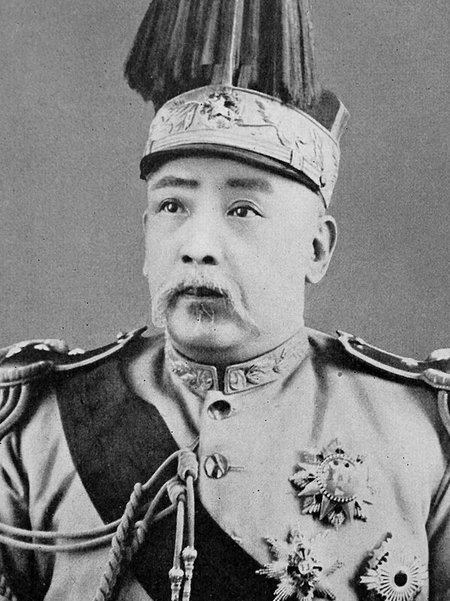
Yuan Shikai
September 16, 1859 – June 6, 1916
Chinese general and statesman who built the Beiyang Army, arranged the abdication of the Qing dynasty and became the first formal president of the Republic of China. He briefly proclaimed himself emperor in 1915–1916.
Biography
Yuan Shikai was born on 16 September 1859 into a well-off Han family in Xiangcheng county. After failing the imperial examinations he joined the Huai Army and was posted to Korea in 1882. His part in suppressing the Gapsin Coup led to his appointment as China's imperial resident in Seoul, a post he held until he was recalled in 1894.
From 1895 he trained the New Army, the core of what became the Beiyang Army. During the reform crisis of 1898 the reformers accused him of betraying their plans to Ronglu, which put him in favour with Empress Dowager Cixi. He governed Shandong, and as Viceroy of Zhili he built the Beiyang Army into China's most effective force and backed late Qing reforms such as the abolition of the imperial examinations. After Cixi's death he was dismissed by the regent Zaifeng.
The Qing court recalled him after the Wuchang Uprising of 1911 and made him prime minister. He negotiated with the revolutionaries, arranged the abdication of the last emperor in February 1912, and in return succeeded Sun Yat-sen as provisional president of the Republic of China, later becoming its first formal president.
As president he crushed the Second Revolution of 1913, banned the Kuomintang and dissolved the National Assembly, and in 1915 he accepted a reduced version of Japan's Twenty-One Demands. In December 1915 he proclaimed himself the Hongxian Emperor, but widespread revolt forced him to abandon the monarchy in March 1916. He died of kidney failure on 6 June 1916.
Offices held
Sun Yat-sen Succeeded by
Feng Guozhang


