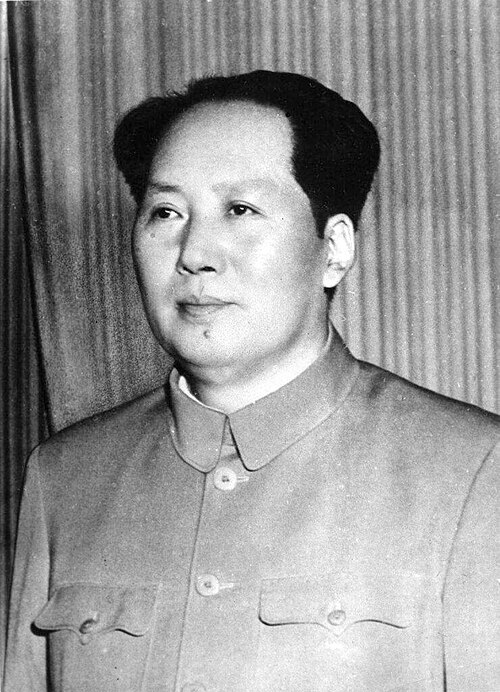
Mao Zedong
December 26, 1893 – September 9, 1976
Mao Zedong (1893-1976) was a Chinese communist revolutionary, political theorist, and the founder of the People's Republic of China. He led China from the PRC's establishment in October 1949 until his death in September 1976, primarily as Chairman of the Chinese Communist Party. He became leader of the CCP during the Long March in 1935, defeated the Nationalist government, which withdrew to Taiwan in 1949, and oversaw land redistribution and industrialization campaigns as well as intervention in the Korean War.
Biography
Mao Zedong was born into a peasant family in Hunan in 1893. He became a Marxist in Beijing after the May Fourth Movement and was a founding member of the Chinese Communist Party in 1921. After the Nationalists turned on the Communists in 1927, he built rural bases in Jiangxi and argued that China's revolution would be made by peasants, not urban workers.
During the Long March of 1934–35 he became the party's leader. He fought the Japanese and the Nationalists from his base at Yan'an, and after the defeat of Japan the Communists won the civil war. On 1 October 1949 he proclaimed the People's Republic of China.
As Chairman he led land reform, the collectivisation of agriculture and campaigns against opponents. The Great Leap Forward of 1958–62 caused a famine in which tens of millions died. In 1966 he launched the Cultural Revolution, which brought a decade of purges and violence. He opened relations with the United States in 1972 and died in 1976.
Offices held
Chen Duxiu Succeeded by
Hua Guofeng
Hua Guofeng
Military service
Affiliations
Party membership
- Jul 23, 1921 – Sep 9, 1976 Communist Party of China Founding delegate at the 1st Congress
- Jan 1, 1923 – Jan 1, 1927 Kuomintang
Family
Mao Zedong
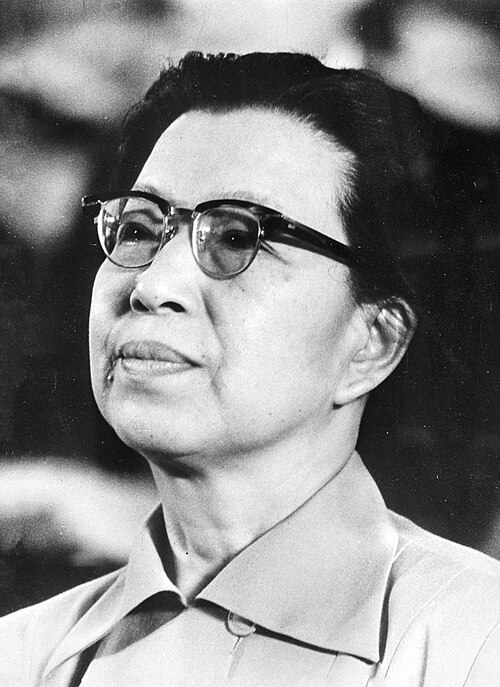 Jiang Qing


